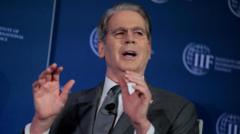
The US Treasury Secretary has sparked controversy by suggesting that short-term economic difficulties are a necessary price to pay for long-term national security. In a statement that has raised eyebrows among economists and policymakers, Scott Bessent argued that a limited period of economic hardship would be a worthwhile sacrifice if it meant eliminating the threat of Iranian strikes on Western cities.
The comments come at a time of heightened tensions between the US and Iran, with both countries engaging in a war of words over issues such as nuclear proliferation and regional influence. The US has been seeking to impose tough sanctions on Iran, which has responded by threatening to retaliate against Western targets. The Treasury Secretary's remarks suggest that the US is willing to take a tough stance against Iran, even if it means enduring some economic pain in the short term.
Critics of the Treasury Secretary's comments have argued that they are overly simplistic and fail to take into account the complex realities of the global economy. They point out that economic sanctions can have far-reaching and unintended consequences, including harming innocent civilians and damaging the economy of the imposing country. Moreover, they argue that the threat of Iranian strikes on Western cities is not necessarily a realistic one, and that a more nuanced approach to diplomacy and foreign policy is needed.
The Treasury Secretary's comments are likely to be seen as a reflection of the US administration's broader approach to national security, which prioritizes a tough and uncompromising stance against perceived threats. While this approach may have its supporters, it is likely to be controversial and may ultimately prove to be counterproductive. As the US and Iran continue to engage in a delicate game of diplomatic brinksmanship, the world will be watching with bated breath to see how events unfold.


Comments (0)